
Distributed antenna systems and shared relay antennas: improving connectivity in complex environments
With the increase in mobile usage and increasingly complex buildings, connectivity has become a major challenge. Distributed Antenna Systems (DAS) and shared relay antennas provide an effective response to ensure optimal mobile coverage inside buildings and in dense environments. TOTEM, an expert towerco in shared telecom infrastructures, supports operators, managers of large complexes, and local authorities in implementing mobile coverage solutions tailored to the architectural and technical specifics of the building for efficient and sustainable connectivity accessible to all mobile operators.
Understanding distributed antenna systems (DAS)
Distributed Antenna Systems (DAS) are telecom infrastructures that amplify and redistribute mobile signals in buildings or areas where 4G/5G mobile coverage is insufficient. Unlike traditional mobile phone antennas, DAS use a network of antennas connected to a single source, thus ensuring homogeneous and quality coverage.
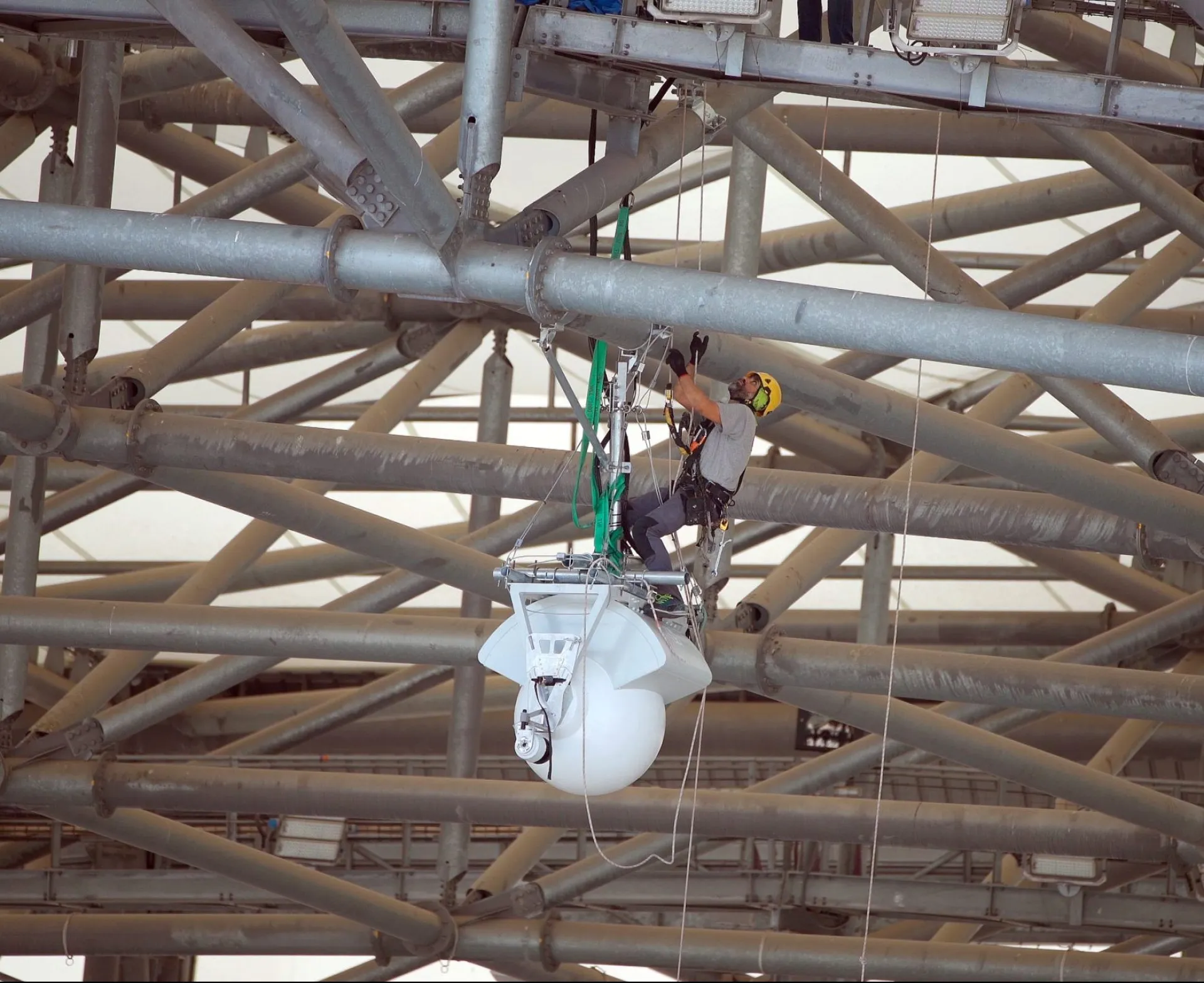
This type of solution is essential in complex urban environments, such as subways, stadiums, as well as offices, hospitals, shopping centers, train stations, or airports, where the structure of buildings can hinder the proper propagation of radio waves and where the complexity of intervention on-site makes the involvement of a towerco meaningful. In this type of project, TOTEM can, depending on its specifics, bear the necessary investment for deploying DAS, which are then shared among several operators to optimize the number of equipment deployed to ensure quality mobile coverage end-to-end.
Why improve mobile coverage in buildings and enclosed spaces?
- They allow for smooth and continuous mobile coverage in enclosed spaces.
- They optimize the signal in modern buildings, often constructed with materials that block waves.
- They adapt to new constructions and recent real estate programs that increasingly integrate smart solutions.
In the face of these challenges, TOTEM provides its infrastructures and expertise to effectively integrate these systems and ensure connectivity tailored to the needs of mobile operators and users.
Why is sharing relay antennas an effective lever for connectivity?
With the rise of mobile networks and increasing urban density, it becomes essential to avoid the multiplication of redundant infrastructures. The sharing of relay antennas optimizes existing installations by offering shared access to different operators, thus reducing urban congestion while ensuring efficient network coverage. The result is better connectivity while limiting the associated environmental impact.
Why share mobile telephony infrastructures?
- Cost reduction: by sharing the same infrastructure, telecom operators decrease their investments and maintenance costs.
- Profitability: for site managers, rental fees linked to the number of operators present on the deployed infrastructures.
- Urban space optimization: avoiding the proliferation of antennas on rooftops and poles.
- Environmental commitment: fewer infrastructures mean a reduction in the carbon footprint related to the installation and energy consumption of equipment.
- Simplicity: for site managers, sharing through a towerco allows them to have a single point of contact for maintenance interventions and also ensures marketing to mobile operators.
TOTEM facilitates this transition by providing its shared infrastructures, guaranteeing high-quality connectivity while reducing the ecological impact of telecom deployments.
How do DAS and shared antennas address connectivity challenges in complex environments?
Modern buildings, large urban centers, and transport infrastructures are particularly challenging environments for deploying mobile networks. The presence of materials that block radio waves, the high density of users, or the need to comply with strict regulations complicates the installation of conventional antennas. This impermeability to waves is known as Faraday cages, which are structures that are impermeable to electric and electromagnetic fields, and can also interfere with the propagation of radio signals. This phenomenon, often observed in trains or in recent buildings, further limits mobile network coverage, making it necessary to optimize communication infrastructures to ensure quality connectivity.
City centers: specific challenges for network coverage
In office buildings, train stations, airports, or hospitals, network coverage is often fragile, or even non-existent, due to numerous interferences and obstacles. DAS and shared antennas provide an effective solution by:
- Eliminating areas without indoor mobile network coverage through a mesh of strategically positioned antennas.
- Improving the quality of mobile network service by avoiding overloading existing infrastructures.
- Adapting to the needs of new buildings where the very structure of the building often blocks signal propagation.
How do DAS and shared antennas improve user experience?
DAS solutions and shared relay antennas optimize user experience:
- Better mobile coverage: users benefit from a stable signal even in traditionally underserved areas.
- Enhanced network capacity: by effectively distributing the load, these infrastructures ensure a homogeneous quality of service, even during peak times.
- Development of new services: a stable network in enclosed spaces allows for the deployment of more modern digital solutions, such as smart building management (e.g., monitoring site traffic or parking availability) or digitized ticketing systems.
TOTEM implements innovative approaches tailored to the specifics of each environment, ensuring optimized connectivity in complex infrastructures.
What long-term benefits can be expected from DAS and shared antennas?
In addition to addressing immediate connectivity challenges, DAS and the mutualization of telecom infrastructures offer significant long-term benefits:
- A sustainable economic model: towercos bear the installation costs, improving the profitability and sustainability of infrastructures.
- Reduced ecological impact: limiting the number of installed antennas helps reduce energy consumption and the carbon footprint of equipment.
- Simplification for property managers: TOTEM becomes a single point of contact, facilitating relationships with operators and marketing of infrastructures.
- Increased attractiveness for buildings and sites hosting the public: with smooth and optimized connectivity, it is possible to integrate advanced digital services (online ticketing, access management systems, smart parking, etc.).
With shared and adapted infrastructures, TOTEM offers a turnkey solution to operators, local authorities, and building managers, ensuring a high-performing and scalable mobile network.
With TOTEM, share your infrastructures for sustainable connectivity
The future of telecommunications relies on optimized, scalable, and environmentally friendly infrastructures.
DAS and shared relay antennas are essential solutions for improving connectivity in enclosed spaces while reducing costs and environmental impact.
TOTEM supports industry players in deploying efficient and shared networks. Its expertise and strategic mesh allow it to address the challenges faced by operators, building managers, and local authorities, while ensuring optimized network coverage.


